


Brands


Categories


Parts Finder


Bikebiz Parramatta

 (02) 8830 0500
Bikebiz
granville
granville


Tell us your bike, we’ll tell you what fits.
Brands
Categories
Parts Finder
Bikebiz Parramatta
Bikebiz
granville
granville
Brands
Categories
Parts Finder
Brands
Categories
Parts Finder

By Michael Catford
|
23 February 2026
|
5 min read
Key takeaways:
The human body didn't evolve to hurtle across tarmac at 100+ kph. (FYI: we would be hideous if it did.) We're delicate bags of meat and bone, so head vs bitumen is always going to be a one-sided fight.
Australian helmet laws state that you need to cover your skull whenever you ride a bike, and a quality lid is perhaps the cheapest life insurance you'll ever buy. But for those with an eye for detail, and who want the best motorcycle crash helmet available, understanding lid ratings – ECE, DOT, Snell, SHARP – can feel a little overwhelming.
At Bikebiz, Sydney's #1 motorcycle dealer, we know skull caps inside out. We've spent over 25 years fitting Australian riders with the best motorcycle crash helmets on the market: the sort that fit perfectly and offer maximum protection.
In this guide, we'll simplify all the jargon to help you understand what helmet safety ratings mean in the real world, and how to use them to find the right lid.
There's no single global safety standard for motorcycle helmets: different ratings apply to different regions. Then there are riding-specific considerations to factor in, like whether you'll be navigating city streets, the highway or the track.
Let's break down the four main helmet safety ratings – ECE, DOT, Snell and SHARP – to understand how they differ.
If any helmet safety rating can be considered global, it's the ECE 22.06 standard. The European benchmark has the most rigorous testing protocols of any standard: helmets are poked and prodded at 22 different impact points, while rotational tests simulate how a helmet behaves when it slides. In short, if a helmet is ECE-certified, you know it's good. The standard was last updated in 2023 – you can check out a comparison of ECE 22.06 vs ECE 22.05 here.
The Department of Transportation rating outlines the minimum requirements for a helmet to be road legal in the US. Where ECE puts helmets through their paces, DOT instead forms a baseline for helmet manufacturers – a set of minimum standards that a lid must meet to be allowed to be used on US roads.
Snell is a racing-focused standard created to understand how helmets cope with high-energy impacts at speeds far beyond road limits. It also assesses multi-hit durability, as it can be tricky to instantly change your lid after a mid-race slide.
The SHARP helmet ratings system takes ECE-certified helmets, then places another layer of analysis on top, rating lids out of five across a range of different testing factors, and giving each one a report card. This independent UK body allows riders to dig into specific differences between helmets.
Even when two lids have the exact same rating, they don't necessarily offer the same level of coverage. There's a significant difference between the experience and protection offered by full face, open face and modular helmets. At Bikebiz, we're experts at matching your riding style with your helmet style.
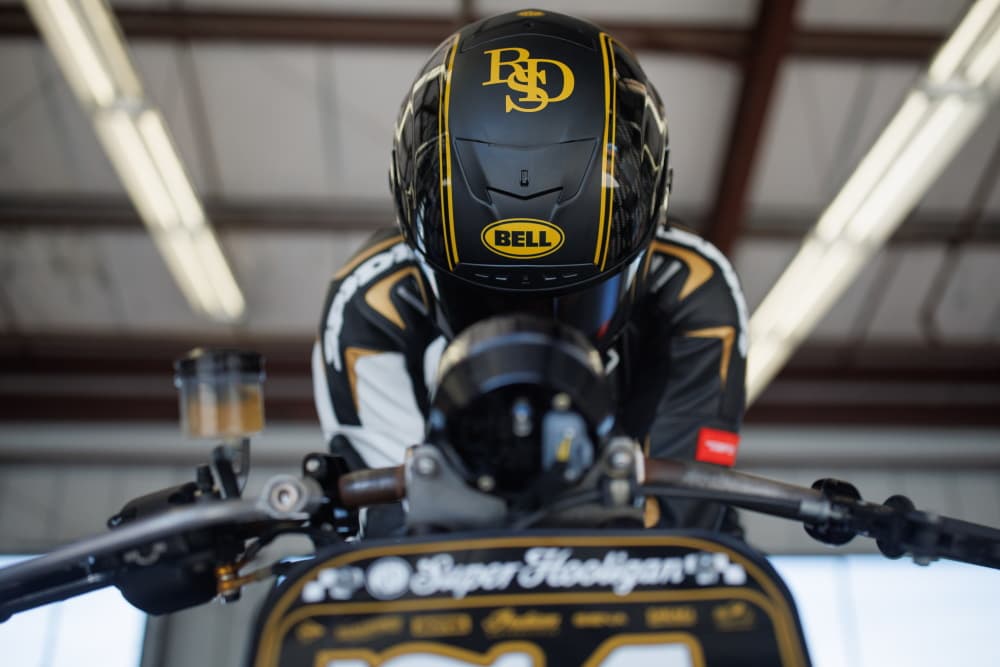
Full face motorcycle helmets remain the benchmark for safety. They cover your entire scone – including the jaw – to provide maximum protection.
Road open face helmets offer great visibility and comfort during low-speed urban cruising, but the trade-off is the lack of chin protection.
With a hinged chin bar and flippable face shield, modular helmets offer the best of both worlds, and are the tourer's choice. Look for a P/J rating that shows the helmet meets both open face and full face standards.
Generally speaking, the higher your speed, the more protection you'll need – both from wind and potential impacts. Open face helmets can be more comfortable at low speeds, but keep in mind that your chin is largely left to fend for itself.
The highest safety rating in the world is useless if your helmet doesn't fit well. Size is critical, but shape can be too: most human heads are what the helmet industry calls an 'intermediate oval', but some manufacturers, like Arai, offer 'long oval' and 'round fit' too. Finding your perfect match maximises comfort and ensures your skull is kept safe if you ever come off.
Speaking of comfort, helmet tech has evolved a lot in the last few decades:
What should your helmet be made from? The choice typically comes down to carbon fibre vs polycarbonate, and the right choice for you will balance price and performance.
Carbon fibre shells – and multi-composites that add in materials like Kevlar – are the premium choice. Strong yet super light, they provide all the strength you need while reducing neck fatigue.
Polycarbonate is a more budget-friendly alternative. It provides all the compliance and protection of a carbon fibre helmet with the same rating, it just weighs more.
| Carbon fibre/composite | Polycarbonate | |
|---|---|---|
| Weight | Extremely lightweight | Heavier |
| Cost | Premium: $800-$2000 | Budget-friendly: $100-1200 |
| Safety | Exceptional energy absorption | Exceptional durability |
| Best for | Track days, racing and long-distance touring | Commuting, budget-conscious riders |
Even if you have never had a spill, your helmet has a use-by date. At Bikebiz we run with the five year rule, which is the length of the warranties from top brands like Shoei, Arai and AGV.
The expanded polystyrene (EPS) that lines the shell and forms the crush zone degrades over time. Exposure to UV, hair oils and sweat makes it brittle, and less effective at absorbing energy.
Critical note: if you have a crash, you replace your lid – no excuses, no exceptions. Helmets are designed to sacrifice themselves once and once only. The EPS absorbs an impact by compressing, like the crumple zone of a car. It isn't designed to bounce back, so it won't be able to absorb a second hit.
Not necessarily. While a higher price tag gets you high-end design and premium materials like carbon fibre, every helmet we sell at Bikebiz meets the same baseline helmet safety ratings. A mid-range lid can be every bit as protective in a spill as a MotoGP model, though the expensive option will probably be lighter and more comfortable.
While the old ECE 22.05 standard did the job, the ECE 22.06 update tests more impact points at a wider range of speeds. It also introduces rotational impact protection testing, to ensure helmets can handle the twisting forces that can be so dangerous in real-world crashes.
Aim for snug, not tight. Look for firm cheek pressure (a chipmunk look is a good sign) and no gap at your forehead. If you shake your head the helmet liner shouldn't move against your skin. If you can fit more than a finger between the liner and your skull, it's probably too big.
Our answer is a firm no. As your mum might say, you don't know where it's been. Hygiene aside, it might be compromised, whether from a crash, or a simple drop on concrete, which can sneakily damage the liner without marking the shell.
Age matters because resins, glues, and the density of the EPS liner degrade over time, from exposure to UV, humidity, sweat and hair oils. As the helmet gets weaker, it provides less protection, so at Bikebiz we recommend investing in a new lid every five years.
Modular motorcycle helmets are incredibly safe, though a full face motorcycle helmet remains the gold standard for protection. If you choose modular, look for a P/J rating, which certifies that the chin bar is safe in both the open and closed positions.
It depends. A waist-high drop onto a soft surface usually won't compress the EPS liner and kill the helmet, but a drop from head height onto concrete can. Not sure whether yours is good to go? Bring it into Bikebiz and we'll give it a once-over.
Motorcyclists are uniquely exposed on the road. You aren't wrapped up in steel and crumple zones – your helmet is your first and last line of defence. As such, a quality lid is perhaps the single most worthwhile investment any rider can make.
Home to Australia's largest range of bike parts and accessories – 30,000+ products, all held in Oz – the Bikebiz store is your go-to destination for the best motorcycle crash helmets. If we don't have it, it's not worth having.
Our recommendation: choose a helmet built to the ECE 22.06 standard, and if you're doing track days, one that is Snell-compliant too.