


Brands


Categories


Parts Finder



Bikebiz Parramatta

 (02) 8830 0500
Bikebiz
granville
granville


Tell us your bike, we’ll tell you what fits.
Brands
Categories
Parts Finder
Bikebiz Parramatta
Bikebiz
granville
granville
Brands
Categories
Parts Finder
Brands
Categories
Parts Finder

By Michael Catford
|
11 February 2026
|
8 min read
Key takeaways:
There was a time when motorcycle comms were limited to a high-speed wave or a tap on the shoulder from the pillion, and your soundtrack was whatever the exhaust pumped out. While this isolation has its charms, today's riders have another option.
A Bluetooth motorcycle helmet can enhance your ride in all sorts of ways: blasting tunes while you're hurtling down the highway, getting guided through city streets by motorcycle GPS navigation audio, bantering while you burn rubber with the crew. It's why the tech has become a non-negotiable for a lot of riders – not a question of whether they have it, but what form it takes.
There are two main options: Bluetooth motorcycle helmets with integrated features, or aftermarket headsets that can be added to any helmet.
At Bikebiz, Sydney's #1 motorcycle dealer, we've spent the last quarter century testing thousands of accessories to separate the gimmicks from the gamechangers. In this guide we break down the pros and cons of both options to help you decide which deserves to take up the prime space around your face.
Integrated Bluetooth helmets are lids with stealthy tech. The motorcycle communication system is housed entirely within the shell of the helmet, which features internal recesses for wiring, speakers, mics and the battery.
The most immediate win here is the clean factory look. With no box catching the air, aerodynamics and balance are high while wind noise is low. The simplicity – one purchase, no setup – is another key selling point.
Integrated Bluetooth helmets aren't all sunshine and rainbows. The cost of simplicity is a lack of control. Locked in to a specific brand, you're at its whim in terms of the devices you can connect to and the regularity of software updates. If you want to upgrade the tech or replace a damaged helmet, you'll need to buy a whole new unit, which won't come cheap.
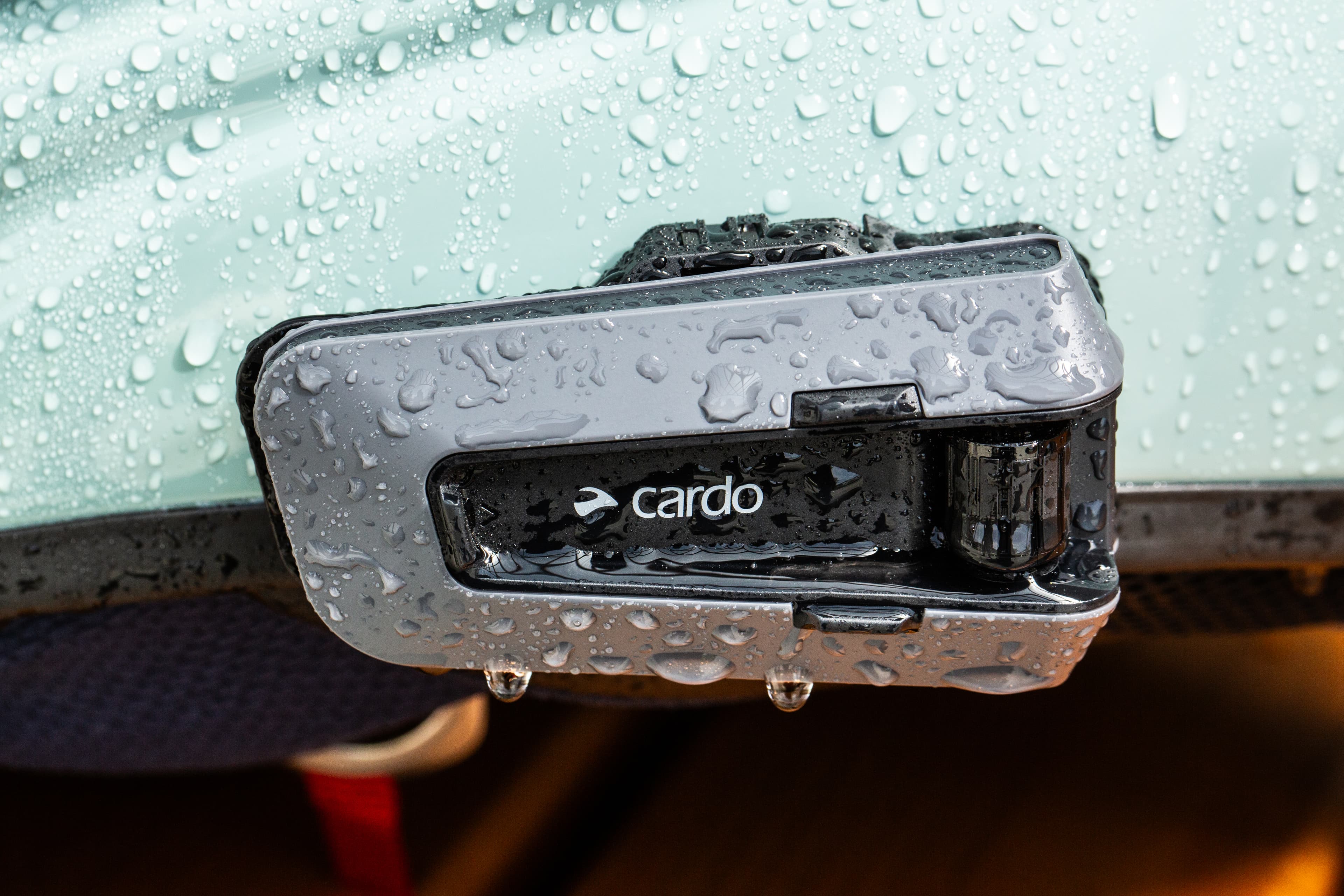
Where the integrated route brings stealth and simplicity, aftermarket motorcycle intercoms are all about performance and versatility. Units like the Cardo Packtalk Edge offer universal helmet pairing, using a mechanical clamp or adhesive mount to attach to the side of almost any lid.
Clamp-on intercom units pair cost-effectiveness with a lack of compromise. You get the latest in rider-to-rider communication tech without being told which helmet you have to wear to get it, and all at a lower price.
To that last point, while installation might feel daunting, it's nothing to stress over. You can DIY or hand it to our team at Bikebiz – we've fitted hundreds.
| Feature | Integrated bluetooth helmet | Aftermarket clamp-on unit |
|---|---|---|
| Cost | Higher: Requires a specific and often premium helmet. | Lower: Typically more cost-effective. |
| Transferability | None: Stays with the helmet for life. | Universal: Swap it between different helmets in minutes. |
| Aesthetics | Sleek, stealthy: Completely hidden within the shell. | Visible: A small unit sits on the side of the lid. |
| Aerodynamics | Superior: Zero extra drag or wind whistle. | Moderate: Can cause slight wind noise at high speeds. |
| Installation | Plug & play: Components have dedicated slots; no mess. | DIY: Requires a small amount of effort routing wires and mounting the unit. |
| Tech longevity | Limited: Often uses older BT versions; harder to update. | Leading edge: Access to tech like Mesh and Bluetooth 5.2. |
| Sound | Standard: Brand-specific (e.g., Sena or N-Com). | Premium options: Aftermarket brands often partner with the likes of JBL, Harman Kardon. |
| Maintenance | Tricky: If the tech fails, the whole lid might need to be replaced. | Easy: Only the unit needs repair or replacement. |
So, are you on Team Integrated, or part of the Aftermarket Crew?
PRO TIP: Need help checking compatibility? We've got you covered. Bikebiz experts can make sure an aftermarket headset will work with your current or preferred helmet.
Yes, Bluetooth helmets are legal across Australia, as long as the lid meets AS/NZS 1698 or ECE 22.05/22.06 safety standards and installation doesn't compromise the structure. At Bikebiz we only stock compliant gear.
Restrictions vary by state so check yours, but in NSW it's legal to use comms as an L- and P-plater, but it's illegal for you to have those comms connected to a mobile phone and to use the mobile functions (e.g. music over Bluetooth).
Bluetooth creates a daisy chain connection which breaks if just one rider falls out of range. Mesh intercom technology is more resilient – it allows the conversation to roll on as individual riders drop in and out.
Yes, most modern aftermarket units offer universal pairing. Some integrated Bluetooth motorcycle helmets only work with the same brand though.
Modern units usually offer 10-15 hours of active talk time – enough for a full day of carving corners or a week of daily commutes. Most of our aftermarket kits also have fast charging, so you can get hours of juice from a quick top-up.
Not at all. Most riders can manage a DIY install in about 20 minutes. But if you aren't feeling confident, no stress, we can take care of it for you.
Yes, waterproof motorcycle headsets are the standard, and premium units like the Cardo Packtalk range are rated to IP67, which means they can survive being immersed in freshwater for up to half an hour.
Ultimately there's no wrong choice between integrated bluetooth helmets and aftermarket headsets. But there is the right choice for your situation.
At Bikebiz we tend to recommend the aftermarket option. It's more cost-effective and versatile, allowing you to simply slap some top tech onto your current helmet. It also gives you the opportunity to change your lid without paying a king's ransom.
Ready to get connected? Home to Australia's largest range – 30,000+ parts for 7,000+ bikes, all held in Oz – the Bikebiz store is your go-to spot for all things intercom.
Last updated: 12 February 2026